STARLITE CREATORS Vol.17 Can convenience and safety coexist? Behind the scenes of Tajima's Sekhmet development
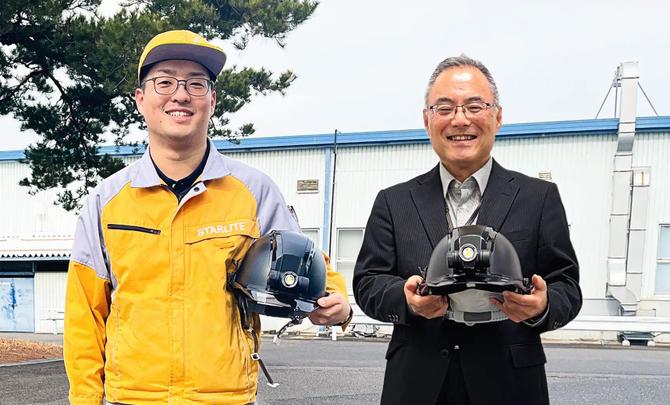
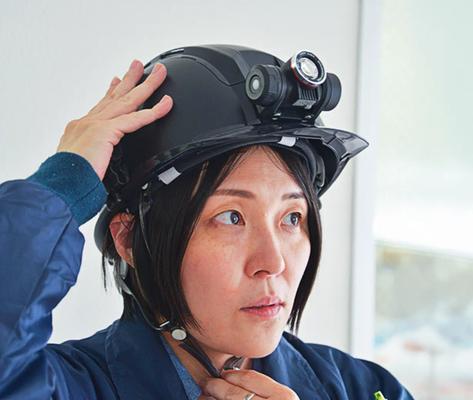
TJM Design Corp. (Tajima) develops and promotes the implementation of the SEF System in the field. It is a system that allows tools and equipment to be attached and removed with a single touch and is widely known among construction workers. The Sekhmet is a helmet equipped with the SEF System. When I first heard about this, I thought if it is just a matter of attaching the SEF to a helmet, it cannot be that hard. But that assumption was completely turned on its head. Helmets must meet various requirements, including safety, comfort, and ease of use. The Sekhmet has light, fan, and SEF System.
In other words, developing the Sekhmet was a challenge that required balancing three elements simultaneously: the SEF System, safety performance, and comfort. Today, I spoke with H.T, the developer, and I.H, the salesperson, who both undertook the challenging task of developing the Sekhmet. I asked them to share the behind-the-scenes story of its development.
First things first, what is the SEF System?
The first challenge was finding the right balance between safety and comfort.
What was the most challenging part of the development process?

H.T: It is about striking a balance between the SEF System, comfort, and safety performance.
What exactly do you mean by "safety performance"?

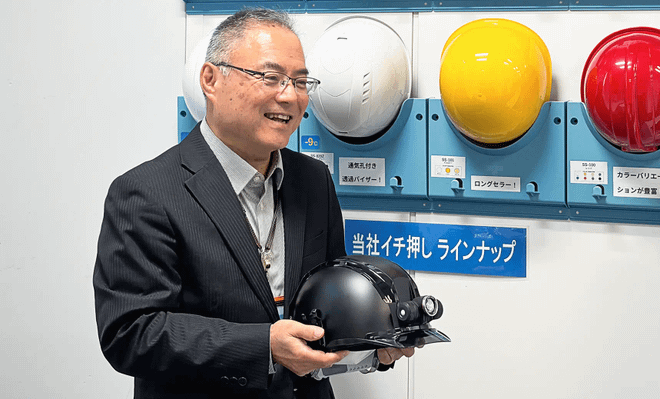
I.H: Helmets are not just hard hats. The structure is designed to absorb impact to the head by using the external helmet shell, the inner impact-absorbing liner, and the space between the two. When an impact occurs, rather than having the helmet shell alone absorb the impact, the entire structure of helmet shell, liner, and space disperses and absorbs the impact, minimizing damage to the head. Therefore, the balance between the shape of the helmet shell, the shape of the liner, and the amount of internal space determines the helmet's safety performance.
H.T: That is why safety performance must be the top priority in helmet design. Impact tests on helmets are conducted to simulate falling objects. The specification value for the impact load transmitted to the head is set at 4.9 kN or less. In terms of weight, this is equivalent to a force of about 500 kg. In other words, by deforming and breaking, helmets are designed to protect the head by absorbing impacts that can easily reach several hundred kilograms of force.
How impact absorption works
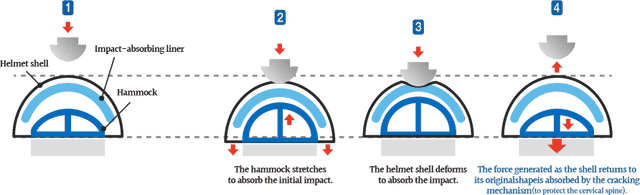
H.T: Although the TC-750R helmet was originally selected for this design due to its relatively spacious interior, the addition of internal components, including the SEF structure, shield, front light, and rear fan housing, is steadily reducing the available space. When that happens, the space to absorb the impact keeps getting smaller and smaller.
I.H: In short, the desire to make things more convenient is incompatible with the design philosophy of ensuring safety. This topic came up several times during meetings.
As a salesperson, I had to take the customers' requests into a design that could be implemented. When the development team informs me that a design cannot pass safety tests, I shift my focus to determining the best way to communicate this to the customer. Then, I guide them toward a suitable alternative. If Tajima firmly prefers a specific design, I work with the development team to explore potential workarounds that meet their requirements. I think it was the kind of job where I acted as a mediator, listening to both sides and shaping it little by little.
H.T: It was reassuring that you arranged meetings with Tajima. In my mind, I see the sales team as the point of contact for customers, so I was worried that I as an engineer stepped in too much. As it turned out, I had total backing to communicate directly with the customer, since our main priority was keeping development on track. I later found out that this kind of proactive approach was deeply embedded in our company culture. After all, I was just a recent graduate back then.
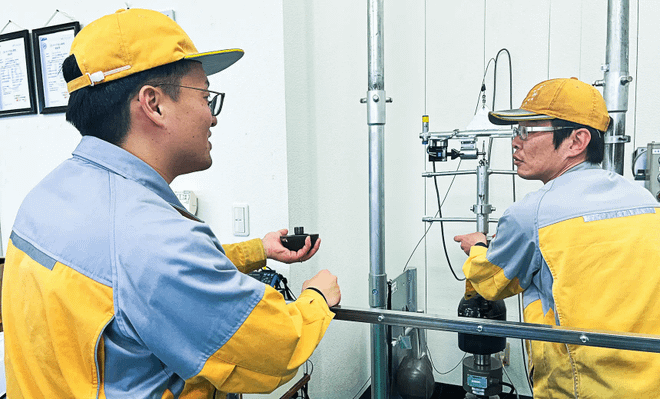
Faced with a reality of 15 kN compared to the specification value of 4.9 kN, the development team began a process of trial and error.
How did you work through those challenges?
I.H: As expected, the most challenging part of the design was the safety testing phase. The shape is taking form, but the test results just did not meet the specification value.
H.T: Yes. To replicate the internal protrusion of the SEF structure, I attached ABS sheets to the inside of the existing TC-750R helmet. I then cut and rearranged the impact-absorbing liner to evaluate which thicknesses and shapes could effectively absorb impacts. It felt like a series of processes involving making slight changes to the shape, testing it, making more changes, and then testing it again.
I.H: I also went to the development field, looking at prototypes and reviewing the test results together. I wanted to identify any potential concerns that Tajima might have during the development phase.
H.T: When focusing solely on the design, I tend to look only at safety and structural issues. I highly value your insight and appreciate you asking how the product actually functions from an end-user perspective.
I.H: Even so, the test results we got after creating the mold and developing a prototype were quite shocking.
H.T: Yes, I will never forget that heavy feeling I had right after the test. The specification value was 4.9 kN, but the test result was 15 kN. That was just impossible. Since the handmade prototype had met the specification value, I thought this might actually work, so it was pretty tough for me at the time.
I.H: But then, people in the testing lab and the production engineering came up to you and said we can think this through together.
H.T: Yes. While observing how the part was struck and deformed, they offered insights from a perspective completely different from my own. For example, they asked where the force concentrated and suggested that it might be better to distribute the impact across this area. They also pointed out that the current shape would be difficult to mass-produce, advising that adjusting the wall thickness in a certain way would strike a better balance between strength and moldability.
Based on the results, we came up with all sorts of ideas. For example, we could trim this part a little to create more space, or we could create some clearance here to help disperse the impact. If I had been thinking about it all by myself, I probably would have gotten stuck and discouraged.
The breakthrough we finally found
How did you meet the impact load standards?
H.T: We designed the rear cover to be used as a cushion. This method involves having the rear cover included as standard equipment and meeting the national certification standards.
I.H: When that idea came up, I thought this might just work.
However, ultimately, we will need to get Tajima's approval. After explaining why this design was chosen, how safety is ensured, and why the rear cover is included as standard equipment, they approved the specifications.
H.T: We were then able to meet the specification value of 4.9 kN or less. At that time, I felt relieved thinking that we could finally see the light at the end of the tunnel, and that I would be able to share good news with everyone who helped and supported us.
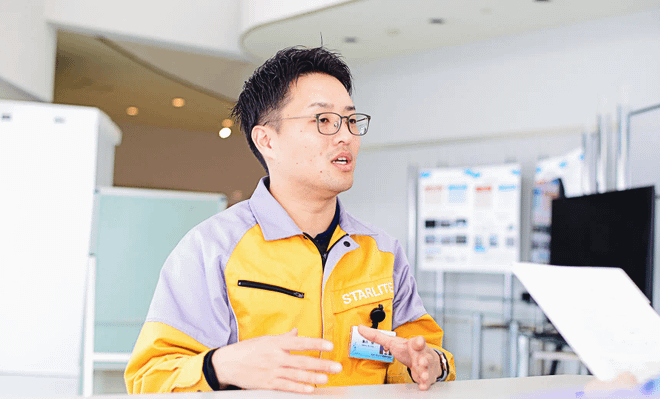
What we learned from working with Tajima
This development project was joint efforts with Tajima. Looking back, is there anything that stands out in your memory?
I.H: Tajima had envisioned installing the SEF System they developed in-house onto helmets. This project began when they reached out to us. Tajima was responsible for the concept and sales, while Starlite handled helmet development.
What really stands out to me was their commitment to thoroughly prioritizing user's perspectives. They were discussing things like how comfortable the helmet is to wear and how it fits, while gathering feedback from the field.
H.T: Honestly, I was mostly just surprised at first because I could not imagine how you would attach tools to a helmet. Since helmets are safety equipment, even a slight change in their shape could affect their safety performance. However, Tajima placed great importance on whether a product was truly easy to use in the field.
In this project, we considered both whether it would function as a helmet and whether it would actually be easy to use in the field. The Sekhmet was born as a result of extensive discussions between both teams.
On to the next helmet
I would like to ask both of you a final question. Through the development of the Sekhmet, what did each of you come to see as the nature of the work involved in making helmets?
I.H: I have worked in the helmet manufacturing industry for many years, and I have always focused primarily on helmets' function as safety equipment. But this project reminded me once again of the importance of considering not just the helmet itself, but the scope of work performed by people in the field and the role the helmet can play in that scenario.
H.T: To be honest, this development project was a series of setbacks. But the very process of constantly thinking about how to actually develop the product was an experience that broadened my knowledge, and I learned a great deal from those setbacks. We are taking on the challenge of developing a new helmet now. Although I am facing a different set of challenges than I did with the Sekhmet, I am actively working on the new design. I am approaching this process with total determination, drawing confidence from our successful delivery of the Sekhmet project with the support of a great team.
Moving forward, I plan to continue raising awareness about the importance of helmets in protecting people's lives. I also intend to develop helmets that improve safety and offer a wider range of features and usability.
Interview Summary
I found it impressive how they not only focused on design but also valued perspectives from testing, production engineering, sales, and customers, and how they overcame challenges by having people from each of these roles share their opinions. Through these interviews, I have realized that our development success does not come from a single person doing all the heavy lifting, but from everyone pulling together to solve complex problems. Even if the results do not come through right away, they change their approach, shift their mindset, and see it through to the end. They never give up. In the end, people are the ones solving problems.
"I am glad we discussed this with you."—We often hear comments like this.
Starlite not only handles design, testing, and mass production, but we also support joint development from the conceptual stage onward, including integration with third-party products and the implementation of new features. We welcome all inquiries, from requests for custom product developments to functional upgrades for existing products. Our team is fully prepared to support you even if your project is still in the conceptual stage. Please contact us.