STARLITE CREATORS Vol.16 The -253°C challenge: Developing the advanced technologies necessary for a leak-free hydrogen society
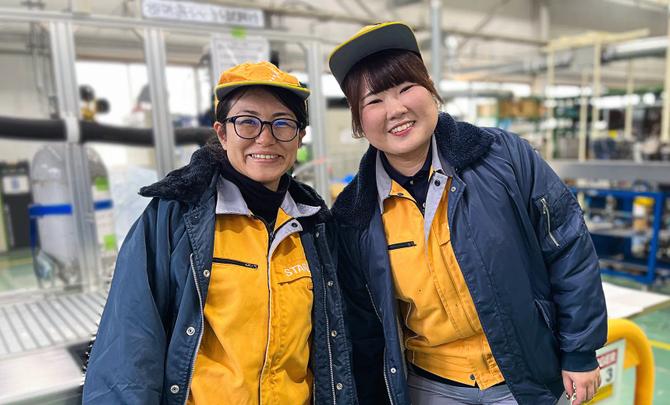
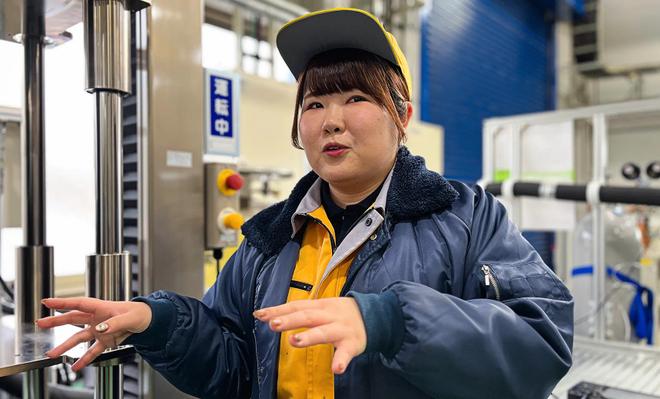
Liquefied natural gas (LNG) is said to help reduce environmental impact, and liquid hydrogen is gaining attention as a new energy source. Did you know that these are handled in environments much colder than Antarctica in the winter? In the cryogenic world, conventional wisdom no longer applies to materials, structures, or evaluation methods. Today, I spoke with M.M, who is developing cryogenic evaluation equipment, and N.N, who uses the evaluation equipment to develop products. These two CREATORS are the ones who develop and use the cryogenic equipment.
What role is Starlite playing in the realization of a hydrogen society?

N.N: A hydrogen society requires the stages of production, transportation and storage, and use. Our products are used in the transportation and storage phase. We are currently developing valve seals for cryogenic applications including liquid hydrogen receiving terminals. We are responsible for the safe control of liquefied gases, ensuring leak-free performance during transportation and storage.
What exactly are valve seals for cryogenic applications?

M.M: A valve is a device that is used to control the flow of liquids or gases. The most familiar example is a faucet. When you turn on the faucet, water comes out. When you turn it off, it stops. It is extremely difficult to achieve this seemingly simple concept using liquid hydrogen at -253°C.
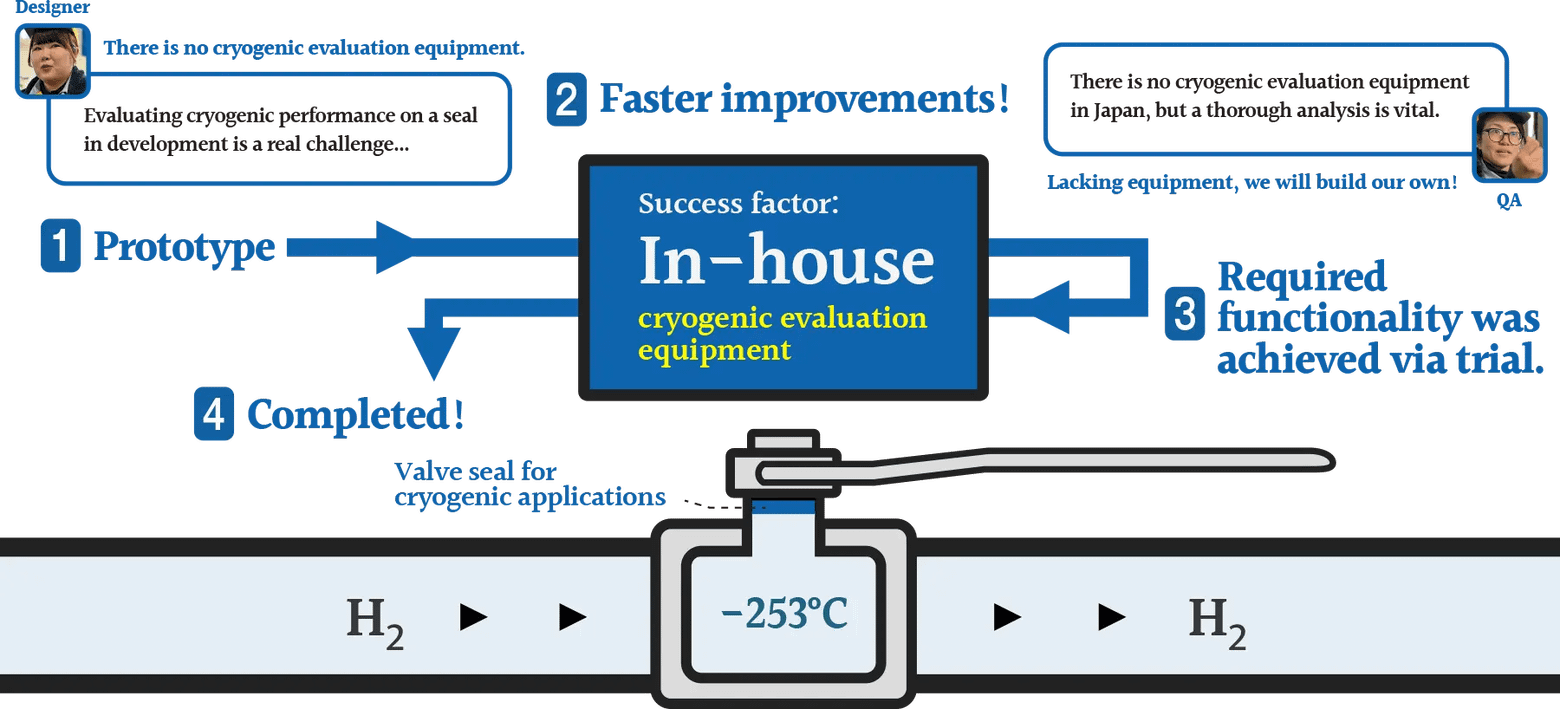
The key is that simply developing a seal is not viable as a product. We repeatedly evaluate the product's functionality in cryogenic environments, revise the design, and reevaluate it until the product is usable. This iterative process is the only way to create a functional product. Starlite develops not only seals, but also its own testing facilities and evaluation technologies to assess performance in cryogenic environments. This enables us to cover the entire process from development to evaluation and commercialization. Our ability to integrate development and evaluation is a major strength in developing products for cryogenic applications.
The journey to a safe and operational valve seal for cryogenic applications even at -253°C
Swipe to continue

The evaluation equipment for cryogenic applications developed in-house was essential to the successful development of the seals.
What were the challenges you faced in developing valve seals?
N.N: It was when we designed a seal that functions in cryogenic environments, where conventional assumptions no longer apply. Under cryogenic conditions, the behavior of materials changes completely compared to the behavior at room temperature. From room temperature down to around −50°C, we can predict the behavior of materials based on past performance data. However, in the range from room temperature to −253°C, we cannot simply extend this line of reasoning.
M.M: Because the degree of thermal shrinkage differs significantly between metals and resins, clearance design becomes extremely critical for seals used in cryogenic environments. This is because the design must accommodate both scenarios: A lack of clearance at room temperature leads to leaks under cryogenic conditions; conversely, if clearance is eliminated at cryogenic temperatures, the components cannot be assembled at room temperature. The only way to confirm that the design works is to conduct evaluations in cryogenic environments. What is crucial here is evaluation technology that works in cryogenic environments.
The secret was developing our own evaluation equipment for cryogenic applications! What were the challenges in developing that evaluation equipment?
M.M: Measuring the precise volume of gas leaking was the most challenging part. The volume of gas leaked is typically measured using a flow meter. However, when we actually ran tests on the first prototype, the amount of gas leaked was so minimal that we could not tell whether the displayed value (volume) was due to air contracting from temperature changes…That really gave me a headache.
At cryogenic environments, gases contract significantly, and even slight differences can affect the results. That was when it hit me. We cannot disclose the method because it is proprietary, but we have now been able to quantify gas leaks.
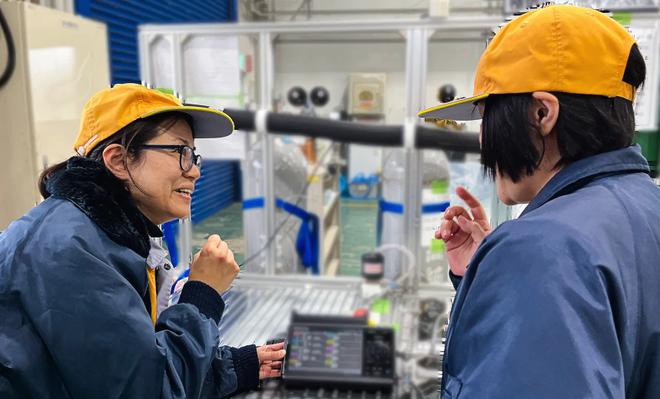
Given that external testing and theoretical analysis were also options, why did you decide to conduct the cryogenic evaluation in-house?
N.N: We also considered relying on testing by external organizations and developing theoretical preparation through AI-driven literature reviews. However, as we continued, we found ourselves in situations more and more often where we did not have enough information to make decisions about product design.
Very few facilities in Japan are capable of conducting evaluations under cryogenic conditions. There is also a lack of data, and few engineers have experience with such measurements. The cryogenic world is unknown that goes beyond the realm of room temperature. You never know what will happen until you try it. That is why I have to evaluate it myself.
M.M: In particular, to determine whether a valve seal was a viable product, it was necessary to conduct evaluations that met all three criteria: 1. no leaking in cryogenic environments, 2. has the ability to maintain the conditions (reproducibility), and 3. the conditions are close to actual use. So, we decided to build the equipment ourselves, evaluate it, and collect as much data as possible to use it for decision-making.
We can turn failure into improvement because we have evaluation results.
Is there a particular moment in the development of cryogenic evaluation equipment that stands out in your memory?
M.M: What I will never forget is the evaluation test for the initial valve seals. There was so much gas leaking that the gauge went off the scale.
N.N: The problem was not with the evaluation equipment. As it turned out, the seal design was the problem.
M.M: All sorts of thoughts crossed my mind at that moment. Where is it shrinking? Where is the clearance forming? Is the leak caused by the seal design, or due to the evaluation equipment or jig? Is the jig used to secure the valve seal misaligned? Does the design allow the operator to set up the sample easily?
As someone who developed the evaluation equipment, that was the moment I started thinking from the user's perspective. After all, we cannot judge the quality of a valve seal design without an environment that reliably collects data and that is user-friendly.
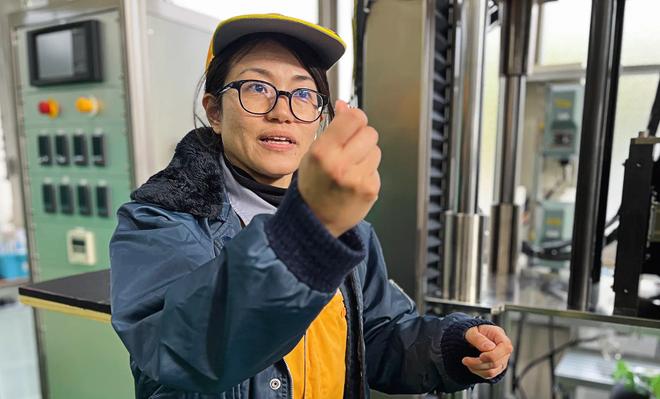
N.N: Then, I made some requests to improve the usability of the equipment. I cannot thank her enough for putting her energy into the jig's shape and layout to ensure the evaluation process went as smoothly as possible.
M.M: Watching her go through design revision after design revision to meet the required performance specifications really motivated me to make sure that the evaluation equipment would not hold her back.
N.N: That is the first time I have heard that. Because I knew the evaluation environment was reliable, I was able to focus on the design changes. After evaluating and prioritizing multiple design proposals, the seal was approved, and it is now in the process of being transferred to mass production. The first mass-produced products have already been delivered to customers, and assembly onto the valve bodies is currently underway. After pilot testing, the product will be phased into hydrogen terminals.
Having the evaluation equipment in-house allows us to quickly try again and again. Even when things did not go as I had hoped, I did not feel like I was at a dead end. It gave me the confidence to update my hypotheses based on the evaluation results rather than acting blindly, and to take the next step.
M.M: Because there are evaluation results, failure does not mean the end. It is an opportunity for improvement. I believe cryogenic evaluation technology serves as the foundation for advancing the development of valve seals.
N.N: We ask customers for the necessary specifications, conduct evaluation tests, and present improved proposals. I believe one of our strengths is our ability to clearly identify why something did not work and what changes were made, and to continue making proposals promptly. Our customers say that we take it more seriously than they do.
The future of cryogenic evaluation technology
The cryogenic evaluation technology seems to have taken shape. What are you looking to do next?
N.N: We think that the knowledge gained here can be applied to other sealing components used in cryogenic environments. I would like to develop seals that can be used at every stage of the future hydrogen society—from production to transportation and storage, and to use.
M.M: I do not think the current evaluation equipment is the final version either. We are looking to develop a jig capable of evaluating seals of all shapes and sizes so that we can help make her dream a reality. I will keep her even busier!
Starlite's challenge to realize a hydrogen society
To realize a hydrogen society, it is essential not only to reduce the environmental impact of energy but also to develop technologies for safely transporting, storing, and using hydrogen. Since much of the LNG and liquid hydrogen is imported from overseas, technologies for transporting them efficiently are important. The method involves converting gas into a liquid. To do so, a cryogenic environment must be created specifically, with temperatures of -162°C for LNG and -253°C for liquid hydrogen.
Starlite is working to develop technologies that support a hydrogen society by advancing sealing and evaluation technologies designed to ensure leak-free and safe control of equipment used in these cryogenic environments. We will continue to pursue technical solutions to the challenges posed by cryogenic environments while providing technical support for the realization of a hydrogen society.
Interview Summary
To be honest, this interview was particularly challenging because there were so many things they could not disclose. Cryogenic evaluation involves conditions and designs that are strictly confidential. Even so, they welcomed me and spoke to me, choosing their words carefully. They could not provide specific figures, but I felt that they wanted to convey the significance of their challenge.
If you cannot measure it, you create an environment where you can. Our valve seals were adopted by customers precisely because of this mindset. They say with confidence that the technology has great potential and can be applied to seals of all shapes. In the cryogenic world, the engineers' passion was the hottest thing of all.
🔗Related Links
We are also developing technologies for the use phase of a hydrogen society. Through our joint research with the Research Center for Hydrogen Industrial Use and Storage at Kyushu University, Starlite's proprietary material ALP has made significant advances in the field of ultra-high pressure hydrogen compressor sealing.
Check out "On Your Side Vol.4 | Kyushu University Hydrogenius × ALP Composite Material Grade for Ultra-High Pressure Hydrogen Compressor Sealing"↗
We often hear from customers: "I didn't realize I could consult with you about this."
Starlite designs and develops its own evaluation equipment as needed to perform evaluations that simulate customers' actual operating environments. Rather than conforming to existing test conditions, we will establish an evaluation environment designed to verify whether it truly functions as intended in real-world conditions. We can start with just a single drawing. Please contact us.